


Finding the Balance Between Security & Convenience
The New Estate Security Challenge: Balancing Convenience with Safety
Residential estates are facing a rapidly evolving security challenge. The rise of e-hailing transport, on-demand grocery deliveries, food delivery services, and courier traffic has fundamentally changed the way people move in and out of secure residential environments. What was once a controlled access ecosystem of residents, guests, contractors, and staff has now become a constant flow of temporary visitors entering estates throughout the day and night. For estate managers, trustees, and security providers, the question is no longer whether these services should be allowed — modern living depends on them. The real challenge is:
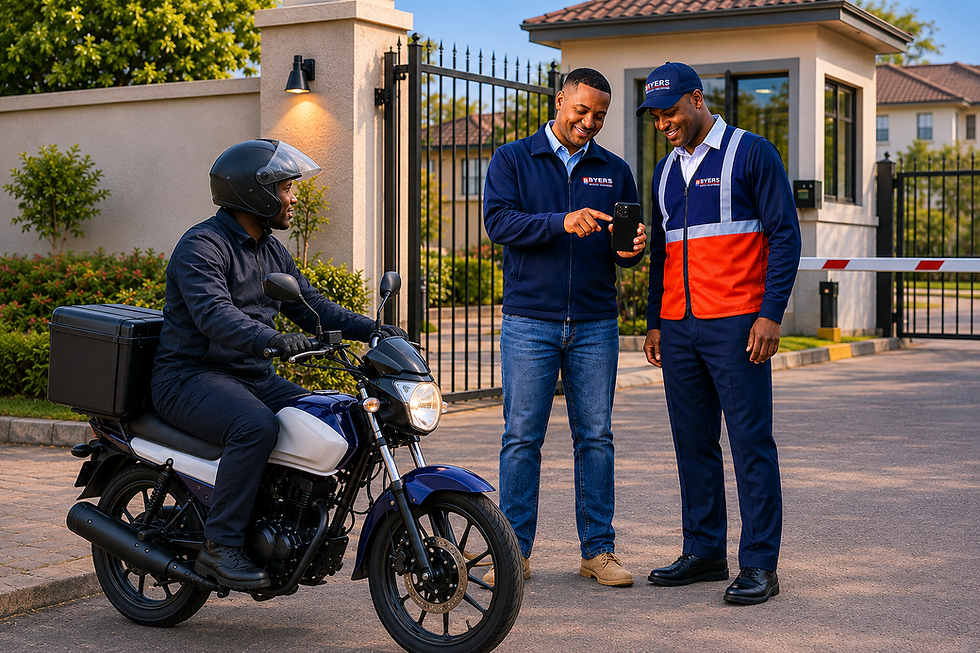
How do estates maintain high-level security while still offering residents the convenience they expect?
The Growing Access Control Dilemma
Residential estates were originally designed around predictable access patterns. Today, security teams may process:
Multiple e-hailing vehicles every hour
Grocery and food deliveries throughout the day
Courier services arriving constantly
Temporary contractors and on-demand services
The challenge is that many of these visitors are:
Unknown to the estate
Time-sensitive
Using changing vehicles
Under pressure to move quickly
Entering multiple estates daily
This creates a difficult balance between:
Resident convenience
Efficient traffic flow
Guardhouse pressure
And maintaining strict security protocols
Why Traditional Access Control Is No Longer Enough
Many estates still rely heavily on manual verification procedures:
Calling residents for approval
Recording visitor details manually
Visual vehicle inspections
Temporary access codes
While these methods still have value, they are increasingly vulnerable to:
Social engineering
Tailgating
Identity fraud
Access fatigue among guards
Human error during busy periods
Criminals are also becoming increasingly aware that delivery and transport vehicles are often perceived as “low-risk” entrants. The reality is that security threats do not always come from forced entry anymore — sometimes they simply arrive through the front gate under the appearance of convenience services.
The Hidden Pressure on Security Teams
Estate security officers are now expected to act as:
Access controllers
Customer service representatives
Traffic managers
Incident responders
Delivery coordinators
During peak delivery periods, guards often face immense pressure from:
Frustrated residents
Impatient drivers
Long vehicle queues
High volumes of repetitive verifications
Without proper systems, this pressure can lead to shortcuts in protocol — which is exactly where security vulnerabilities emerge.
Finding the Balance Between Safety and Convenience
The solution is not to block modern convenience services. Instead, estates need smarter layered security strategies that support both security and resident lifestyle expectations.
1. Digitised Visitor Management
Modern estates are moving toward:
Mobile pre-authorisation systems
QR code visitor access
Automated resident notifications
Digital audit trails
Vehicle recognition technology
These systems reduce manual guard intervention while improving accountability and traceability.
2. Dedicated Delivery Protocols
Estates should establish clear operating procedures for:
E-hailing vehicles
Delivery drivers
Courier services
Temporary service providers
This may include:
Separate delivery lanes
Waiting zones
Restricted movement permissions
Time-limited access credentials
The goal is controlled convenience — not unrestricted access.
Residents Also Play a Role
Convenience should never replace awareness. Residents should:
Avoid authorising unknown visitors
Ensure deliveries are expected
Report suspicious behaviour immediately
Understand and respect estate access procedures
Many estates now hold residents accountable for the conduct of visitors and service providers they authorise onto the property as well as implement procedures with drop off and collection points.
The Future of Residential Estate Security
The modern estate is no longer simply protecting against external threats. It is managing the safe movement of hundreds of legitimate short-term visitors every single day.
As residential lifestyles continue evolving, estate security must evolve with them.
The future lies in:
Smarter technology
Better access management
Clear operational procedures
Properly trained security personnel
And strong cooperation between residents, HOAs, and security providers
Because in today’s environment, the safest estates are not necessarily the strictest — they are the ones that manage convenience intelligently without compromising security.


Comments